Free agent wide receiver Stefon Diggs is set to sign a one-year deal worth up to $12 million with the Washington Commanders, giving the team a proven receiver opposite Terry McLaurin, sources told NFL Network’s Ian Rapoport and ESPN’s Adam Schefter. The move ends months of speculation about a hometown reunion and gives quarterback Jayden Daniels a genuine second option in the passing game heading into the 2026 season.
The Deal
The 32-year-old, four-time Pro Bowler was released by the New England Patriots in March after one productive season, in which he caught 85 passes for 1,013 yards and four touchdowns across 17 games and helped lead New England to Super Bowl LX. His 83.3% catch rate that season ranked as the second-highest by a wide receiver over the past 45 seasons, according to CBS Sports Research. New England moved on largely for financial reasons — Diggs’ cap hit was set to jump from $10.5 million to $26.5 million in each of the next two seasons under his old deal.
The new arrangement with Washington is a one-year prove-it contract, which keeps Diggs’ options open again next offseason but also puts real pressure on him to perform in 2026. It’s the fourth different team he’ll have played for in as many seasons, following stops with the Minnesota Vikings, Buffalo Bills and Houston Texans before landing in Washington.
Sources: The #Commanders and 2x All-Pro WR Stefon Diggs have had deep discussions and there’s mutual interest in doing a deal.
Diggs is a Maryland native who played collegiately at the University of Maryland, giving this signing a homecoming element — but according to ESPN’s reporting, that wasn’t the driving force behind it. The two sides had been talking for some time, and while the personal ties made a deal easier to close, this was primarily about giving Daniels and Washington’s offense a legitimate second threat.
The need was real. Washington’s receiver room had been widely criticized for lacking star power as training camp opened, with McLaurin — who missed seven games last season due to a leg injury — as the only established name. Diggs immediately slides in as the No. 2, pairing with McLaurin to give new offensive coordinator David Blough two proven veteran targets to build his first playcalling script around.
Diggs made his own case for that role clear in a video posted to his YouTube channel in July, arguing that regardless of who’s labeled the top receiver on a roster, “you can’t name a No. 2 better than me.” Now he gets the chance to prove it in Washington’s uniform.
The signing also appears to close the book on Washington’s long-rumored interest in Brandon Aiyuk. The Commanders had been monitoring Aiyuk’s situation with the San Francisco 49ers earlier in the offseason and would have had interest had he become available. But per ESPN, that interest cooled significantly after a string of Aiyuk social media posts — some of which directly targeted Daniels. Aiyuk, who hasn’t played in a regular-season game since tearing his ACL in October 2024, has also not applied for reinstatement from the reserve/did-not-report list as of this week, and San Francisco has already voided the remaining guaranteed money on his contract. With Diggs now in the fold, Washington has little remaining reason to pursue that scenario.
What It Means for the Room
Diggs’ arrival reshapes a receiver depth chart that also includes Antonio Williams, Treylon Burks, Luke McCaffrey and Dyami Brown, giving those younger players a clearer, more defined role rather than being pushed into a No. 2 job before they were ready. It also takes pressure off McLaurin, who no longer has to be Washington’s only proven perimeter threat every week.
For Daniels, entering a critical second full season under center in Blough’s new system, adding a receiver of Diggs’ caliber — even at 32 and on a “prove it” deal — meaningfully raises the offense’s ceiling. The move signals that general manager Adam Peters wasn’t willing to enter the 2026 season relying on unproven depth at a premium offensive position, even with a young quarterback still early in his career.
Diggs is expected to join the team and begin practicing in the coming days as Washington continues its ramp-up toward the preseason.
The WNBA has suspended Seattle Storm co-owner Celeste Keaton from attending the team’s next five home games after a confrontation with two teenage fans during Tuesday night’s game against the Indiana Fever, the league confirmed Thursday. Keaton was also fined an undisclosed amount. The punishment caps 48 hours that pulled an entire WNBA franchise into the center of the league’s ongoing fight over Sophie Cunningham’s comments on transgender athletes — and it has left almost no one satisfied.
What Happened at Climate Pledge Arena
Tuesday’s game had drama attached before it even tipped off. A pregame rally outside Climate Pledge Arena brought a few dozen supporters of Fever guard Sophie Cunningham, whose comments opposing transgender participation in women’s sports had drawn national attention the week before. A smaller group of counter-protesters supporting transgender inclusion gathered as well.
Inside the arena, two 16-year-old fans sat courtside wearing shirts from XX-XY Athletics — a brand built around opposition to transgender inclusion in women’s sports — and held signs reading “We love you Sophie” and “Thank you Sophie for speaking up for girls.” According to the girls, who later spoke to independent journalist Brandi Kruse on the “Undivided” podcast, they were cheering for both teams and being “respectful” throughout the night.
That’s when, they say, a woman approached them. The girls described being told “Jesus loves everyone,” that she hoped “Jesus could forgive” them, and being called “f—ing insane” — with one saying she was left in tears by the exchange. Kruse identified the woman as Celeste Keaton, a Seattle Storm co-owner. Some fans in attendance also reported Storm players directing thumbs-down gestures toward the girls during the game, adding another layer to an already tense night. Indiana went on to beat Seattle 105-95, extending the Fever’s win streak, behind a team-high 32 points from Caitlin Clark. Neither Cunningham nor Clark were made available for postgame interviews.
I've been asked for this video by various outlets. Anyone is free to use it. Here you go. This is Ahnaleigh Wilson and her friend (prefers not to be named) explaining to me what Storm co-owner Celeste Keaton said to them. pic.twitter.com/246r4yVwIC
The Storm organization moved quickly to distance itself from Keaton’s alleged conduct. In a statement released Wednesday, majority owner Ginny Gilder said: “We are aware one of our co-owners made comments to two fans in attendance at last night’s game. We apologize that this happened. Everyone who attends a Storm game deserves to feel welcome, and we remain committed to creating an inclusive environment where every fan is treated with respect.”
That apology wasn’t the end of it. By Thursday, the WNBA confirmed to multiple outlets, including ESPN, that Keaton — who is married to Storm co-owner Lisa Brummel and holds ownership status of her own — would be barred from attending the team’s next five home games, along with a fine. Practically, that means Keaton won’t be permitted back into Climate Pledge Arena for a Storm game until September.
Cunningham herself weighed in on X after news of the suspension broke, writing in part that she believes “there is a safe space and love for EVERYBODY. Biological girls, biological boys, trans women, and trans men. Everyone is welcome at my table! You can disagree and still be kind.” She praised the two fans for “standing up for what they believe,” said she planned to send them gifts, and called Keaton’s actions “truly embarrassing.”
Seattle Storm minority owner Celeste Keaton has been fined by the WNBA and suspended for her team's next five home games following an incident Tuesday night involving a pair of Sophie Cunningham fans, per @CasNegley
If the suspension was meant to close the story, it did the opposite. The reaction split almost immediately along the same lines as the underlying debate over Cunningham’s comments.
One side saw the punishment as insufficient — pointing out that a co-owner allegedly reduced a teenager to tears and only lost access to five home games. The other side erupted in the opposite direction, arguing Keaton was being punished for a personal reaction to a politically charged display inside her own team’s arena, with some fans online writing that “she did nothing wrong” and accusing the league of “picking a side.”
That’s the bind Commissioner Cathy Engelbert’s office finds itself in: virtually any level of discipline here was going to be read by one side as too lenient and by the other as an overcorrection. Notably, this isn’t happening in isolation — it lands in the same stretch as ESPN reporting that more than 20 league stakeholders have privately questioned whether Engelbert is equipped to handle the WNBA’s current run of controversies, and just days after the league quietly fumbled a separate story when it briefly posted, then deleted, video of Paige Bueckers and Angel Reese appearing to violate the league’s anti-gambling rules with a friendly wager during All-Star Weekend.
Where This Leaves the Storm
For a franchise that has otherwise stayed out of this season’s biggest storylines, the Storm now find themselves at the center of one of the WNBA’s most politically charged moments — not because of anything that happened on the court, but because of who was sitting in the stands, and who confronted them. Ginny Gilder’s apology drew a clear line between team ownership and Keaton’s conduct, but a five-game suspension for a co-owner is a rare enough disciplinary action that it will likely follow the Storm’s brand for the rest of the season, regardless of how the discourse around Cunningham’s comments eventually settles.
What happens next is unclear. Keaton has not publicly commented on the incident or the discipline as of this writing. Cunningham, for her part, has shown no sign of backing off her original comments, telling reporters last week she considers her position “common sense.” With the Fever and Storm not scheduled to meet again this regular season, the two sides most directly involved may not cross paths again — but the underlying fight clearly isn’t finished with either franchise.
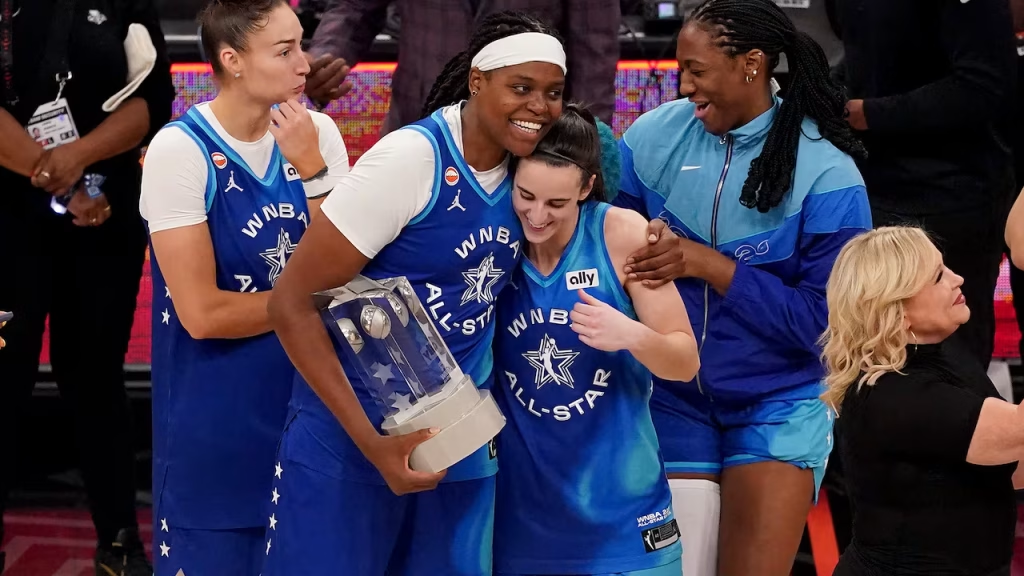
The 2026 WNBA All-Star Game delivered on every front Saturday night at the United Center, as a record crowd watched Caitlin Clark’s Team Spoon outlast Marina Mabrey and Team Coop, 129-122, in a night that mixed history-making performances with a growing storyline around Commissioner Cathy Engelbert’s leadership.
Record Crowd, Record Season
A total of 19,783 fans packed the United Center, setting a new all-time attendance record for a WNBA All-Star Game — topping the previous mark of 19,487, which had stood since 2007. It was a sharp jump from last year’s 16,988 in Indianapolis, and a clear sign of how far the league has come since it last brought the All-Star Game to Chicago in 2022, when the event was held at the smaller Wintrust Arena.
Engelbert used her pregame news conference to frame the weekend as part of a broader breakout season. She noted the league has already surpassed 73 million unique viewers through 117 broadcasts this season — more than the entirety of last season’s record 63 million — and that 29 games have averaged over a million viewers so far, compared to just 11 for all of last season. Attendance leaguewide is up 16% year over year, with more than 2.2 million fans through games at the season’s halfway point. Calling it the league’s “largest, most immersive, and most accessible” All-Star Weekend yet, Engelbert said the growth reflects investments in both player and fan experience.
Cathy Engelbert on online hate directed at WNBA players:
"The racism, the misogyny, the homophobia, the harassment, and threats directed to our players, has no place in sport or anywhere else."pic.twitter.com/Oghr1OdY9K
Named for Liberty general manager Teresa Weatherspoon, Team Spoon jumped out to an early lead behind long-range shooting from Clark and never fully let go of it, despite a late push from Team Coop (named for Cynthia Cooper-Dyke) that cut the deficit to single digits. The final score, 129-122, capped a game with 127 combined three-point attempts and very little defense — exactly the kind of showcase All-Star weekend is built for.
Eight Team Spoon players scored in double figures. Clark finished with 17 points, four rebounds and five assists, while Allisha Gray added 19 points off the bench. Rookie Olivia Miles nearly posted a triple-double, finishing with 11 points, 12 rebounds and two assists shy of the mark — making her just the third rookie in All-Star Game history to record a double-double.
For Team Coop, Kelsey Mitchell led all scorers with 28 points, with Marina Mabrey adding 23 off the bench, Paige Bueckers contributing 12 points and seven assists, and Dominique Malonga posting a 12-point, 13-rebound double-double. At 20 years old, Malonga became the youngest player in WNBA history to record an All-Star Game double-double.
The biggest individual story of the night belonged to Liberty center Jonquel Jones, who came off the bench to post 22 points, 13 rebounds and eight assists — two assists shy of a triple-double — en route to All-Star Game MVP honors.
The performance made Jones the first player in WNBA history to win all four of the league’s marquee MVP awards: regular-season MVP (2021, with the Connecticut Sun), Commissioner’s Cup MVP (2023), WNBA Finals MVP (2024), and now All-Star Game MVP (2026). She’s also the first player to record double-doubles in four separate All-Star Games.
Jones dedicated the win to her aunt, Marilyn Anita Knowles, who died recently; the game fell on the day of her memorial. “My aunt passed away not too long ago, and today is actually her memorial. I got permission from my family to be here and to celebrate this moment,” Jones said afterward. “This one is for my auntie.”
Jones wasn’t the only player to make history Saturday. Seattle’s Nneka Ogwumike, entering the night second on the All-Star Game’s all-time scoring list behind Maya Moore, scored 11 points to move into first place with 127 career All-Star points.
The Other Story Line: Engelbert’s Leadership Under the Microscope
Even amid the celebration, the weekend doubled as a referendum on Engelbert’s leadership, a topic that has followed her for weeks. Asked to describe her relationship with the commissioner, four-time MVP A’ja Wilson gave a pointed but lighthearted answer, saying her main interaction with Engelbert comes when accepting trophies from her.
Engelbert acknowledged the criticism directly, telling reporters she plans to “institute more frequent communication” with players going forward — including texting them more regularly. It was a notable admission from a commissioner who is currently facing questions about whether her contract, which expires at the end of this year, will be renewed. WNBA players’ union president Nneka Ogwumike declined to say directly whether she believes Engelbert should stay on, saying only that the union will “rock with” whoever is in the role.
Engelbert also addressed player safety and online harassment during her availability, an issue that has intensified this season following high-profile incidents involving Caitlin Clark.
Takeaway
The 2026 All-Star Game captured a league in the middle of two stories happening at once: a business and viewership boom that’s setting records on almost every front, and a leadership credibility question that isn’t going away just because the arena was full. Jonquel Jones’ historic MVP performance and the record crowd will be the headline; whether Engelbert’s promised “more frequent communication” changes the tenor of that second story is one of the bigger threads to watch as the second half of the season begins.
Kelsey Mitchell’s sneaker future has officially been decided, and it has Indianapolis written all over it. The three-time WNBA All-Star, who has quietly built one of the most efficient and underappreciated scoring résumés in the league, signed an endorsement deal with PUMA Basketball on Monday — becoming the first athlete to join Indiana Pacers guard Tyrese Haliburton’s signature Hali franchise.
For Fever fans who have watched Mitchell lace up different colorways of the Hali 1 throughout the early stretch of the 2026 season, the announcement was less of a surprise and more of a confirmation. What started as an on-court fashion choice has turned into a full-fledged partnership — and the first step in what PUMA is positioning as a genuine basketball sub-brand built around its breakout Pacers star.
From Free Agent to Family: How the Deal Came Together
Mitchell’s previous deal with Nike ran out in early 2026. Rather than rush into a new sponsorship, she spent the opening stretch of the season as a sneaker free agent, testing out different brands and styles on the court while she figured out where she wanted to land. “I’m just kind of figuring some things out and trying some things out,” Mitchell said. “But I said, ‘Why not?’”
That openness eventually pointed her toward the Hali 1, Haliburton’s debut signature shoe with PUMA, which launched roughly nine months ago. Since the start of training camp, Mitchell wore the shoe in every single Fever game this season — a real-time audition that ultimately became impossible for PUMA to ignore. “In the city of Indianapolis, with a guy like Tyrese Haliburton and all of the things he’s done for the Pacers, it was only right to see where I’m at,” Mitchell said. “PUMA feels really good today, so shout-out to Tyrese.”
The connection between the two stars runs deeper than shoe choice. Both Mitchell and Haliburton wear No. 0 for their respective Indianapolis franchises, and both have become the offensive engines of teams chasing championship relevance. Haliburton, a self-described basketball junkie, has sat courtside for the majority of Fever home games this season and has posted on social media multiple times about Mitchell wearing his shoes — including a post over the weekend before the deal became official that signaled an announcement was close.
Mitchell described the signing as one of the more natural partnerships of her career. “This partnership felt authentic from the start,” she said in PUMA’s official release. “PUMA continues to push basketball culture forward in a creative and meaningful way. Being connected to a brand that values self-expression, performance, and community means a lot to me. Seeing the success Tyrese has had with the Hali shoe from day one, I’m excited to team up with him and PUMA to trailblaze the Hali franchise into the women’s game.”
Haliburton returned the praise with a statement that spoke to far more than basketball. “Kelsey is one of the toughest competitors I know and somebody who has always stayed true to herself,” Haliburton said. “She’s earned everything through hard work and consistency, and I’m excited to see the contribution she will make to the Hali franchise as part of the PUMA family. The game continues to grow because of players like her.”
PUMA Basketball vice president Archie McEachern echoed that sentiment in welcoming Mitchell to the roster. “Kelsey represents everything we value at PUMA Hoops — confidence, competitiveness, individuality, and a genuine connection to the game,” McEachern said. “Her impact on and off the court continues to grow, and we’re excited to welcome her to the family.
Kelsey Mitchell is no longer a sneaker free agent.
The 3x WNBA All-Star has worn Hali 1 shoes since camp and on Monday, she signed a deal with PUMA to be part of Tyrese Haliburton's Hali franchise.
What makes Mitchell’s signing notable beyond the friendship angle is the structural significance of the deal. PUMA’s official press release specifically states that the partnership with Mitchell is “built upon the vision and support of Tyrese Haliburton to add high-caliber athletes to his signature Hali franchise.” In other words, Mitchell isn’t simply a PUMA-sponsored athlete who happens to wear Haliburton’s shoe — she is the first official member of an emerging sub-brand, with Haliburton functioning less like a typical signature athlete and more like the face of a growing roster, the way Jordan Brand operates under the wider Nike umbrella.
The Hali 1 only launched roughly nine months before Mitchell’s signing, making this an unusually fast turnaround from solo signature shoe to multi-athlete franchise. It raises an obvious question for sneaker watchers: could Tyrese Haliburton’s PUMA line eventually build out a full stable of athletes carrying the Hali name, with Mitchell as just the first of several signings to come? PUMA’s language suggests that is very much the plan, and Mitchell will likely receive her own player-exclusive colorways of the Hali 1 in the near future as the partnership develops.
Mitchell Joins a Growing PUMA Presence in the WNBA
Mitchell’s signing adds her to an expanding list of WNBA stars with ties to PUMA, including Breanna Stewart, Skylar Diggins, and NaLyssa Smith. Stewart remains the most prominent name in that group, with her own signature shoe, the PUMA Stewie, already a fixture in the women’s basketball sneaker market. Mitchell’s arrival under the Hali umbrella gives PUMA a second distinct pathway into women’s basketball — one tied directly to one of the league’s most marketable rising stars rather than an established veteran.
The timing lines up with a breakout season for Mitchell on the court. She has appeared in every single Fever game in 2026, averaging 21.6 points per game — third-best in the WNBA — and is on pace for her fourth consecutive All-Star selection. She finished fifth in MVP voting a season ago and chose to stay in the United States to play in Unrivaled this past offseason rather than heading overseas, a decision that kept her in front of American audiences and almost certainly raised her commercial profile in the process.
What Comes Next
For now, Mitchell will continue wearing the Hali 1 in Fever games as the partnership formally takes shape behind the scenes. Given PUMA’s stated ambition to grow the Hali franchise into a multi-athlete brand and Mitchell’s status as its first signee, speculation will naturally turn to whether a Mitchell-specific colorway — or eventually a fully separate signature shoe — is somewhere down the road.
Two No. 0s. Two Indianapolis franchises. One growing sneaker family. As the Fever push through the back half of the 2026 season and the Pacers organization continues to lean into Haliburton as the face of the city’s basketball future, Mitchell’s PUMA signing is one more sign of how tightly the worlds of Indiana’s men’s and women’s basketball stars have become intertwined — on the court, and now, on the shelf.
NEW YORK — The WNBA made it official on Thursday afternoon, announcing that Phoenix Mercury forward Alyssa Thomas has been suspended for one game after the league retroactively assessed her a Flagrant Foul 2 penalty for recklessly making contact with her fist to the throat area of Indiana Fever superstar Caitlin Clark during Wednesday night’s 111-109 Mercury victory at Gainbridge Fieldhouse in Indianapolis.
The league determined that Thomas committed a non-basketball act with 6:52 remaining in the second quarter — a ruling that triggered an automatic one-game suspension under the WNBA’s Flagrant Foul point accumulation policy. Thomas will serve her suspension Saturday when the Mercury visit the Toronto Tempo. No foul of any kind had been called on the play during the game itself, with officials later telling Fever head coach Stephanie White at halftime that they simply did not see the contact occur.
What Happened on the Court
The sequence that sparked the suspension began innocuously enough. Clark drove into the lane and tumbled onto her side after making contact with Mercury defender Lexi Held. As the ball came loose on the floor, Held, Thomas, and DeWanna Bonner collapsed onto Clark in a scramble to recover the possession. What happened next, captured clearly on video that circulated globally within hours, was the moment that made suspension inevitable: as the other players began to rise, Thomas pressed her closed right fist directly into Clark’s throat area, then stood up and deliberately stepped over her as she remained on the hardwood.
The ball was not in dispute at the point of contact. There was no basketball play being made. A baseline referee was positioned directly in the area with a clear sightline to the incident. No whistle came. Clark, visibly shaken, stayed in the game through the remainder of the second quarter but was already dealing with the back injury that has been listed on the Indiana Fever’s injury report since the season’s very first game.
The contact to Clark’s throat was not the only no-call that drew scrutiny Wednesday. Just minutes later in the same quarter, Phoenix defender Valeriane Ayayi closed out on Clark’s three-point attempt and landed on Clark’s foot as she came down — a play the officials reviewed but declined to upgrade to a reckless foul. Clark was grabbing at her back in the aftermath of that second play and, despite remaining in the game temporarily, exited for good with 5:51 left in the third quarter. She did not return. She finished with 19 points and 8 assists in just 20 minutes of play.
Caitlin Clark and every WNBA player should be protected from this targeted behavior. pic.twitter.com/JHXI6CBIbX
White Calls It “Egregious and Utterly Disrespectful”
Fever head coach Stephanie White did not hold back in her postgame press conference, delivering one of the most impassioned defenses of a player by their coach in recent WNBA memory. White said she learned of the Thomas incident at halftime and immediately brought it to the attention of the officiating crew — yet Indiana was still assessed 11 fouls in the fourth quarter compared to Phoenix’s two, and the Mercury attempted 24 free throws in the second half alone.
“It was egregious. The fact that it was a no-call — number one, you gotta call it. It’s absolutely egregious and utterly disrespectful,” White told reporters. “And then number two, you’re coming in here aware of what happened two nights ago, and that still happens? Absolutely unacceptable. Absolutely unacceptable. We have a generational talent and a WNBA superstar who had two cheap shots right there that weren’t called.”
White went further, addressing what she sees as a systemic consistency problem in how Clark is officiated compared to other superstars in the league. “We spent all offseason looking at officiating,” White said. “All offseason. And I still say the one thing that we keep asking for is consistency. She is not called the same way everybody else is called. The fist in the throat is crazy. It’s crazy. It’s dangerous. When you have these things continue to happen time and time and time again, eventually it gets frustrating.”
Stephanie White goes off on the refs on the AT fist to Caitlin & other no calls:
"The fact that it was a no-call, it's absolutely egregious & utterly disrespectful. We have a generational talent and a WNBA superstar, who had two cheap shots right there that weren't called. She… pic.twitter.com/fK8NqaBuss
Wednesday’s suspension is the first of Alyssa Thomas’ 13-year professional career — a remarkable fact given her history of physical play that has drawn controversy at multiple points across her tenure in the league. Thomas received a flagrant foul earlier this season for striking Washington Mystics rookie Kiki Iriafen in the throat with an elbow during a free throw rebound. She was also assessed a Flagrant 2 and ejected during Angel Reese’s rookie season after throwing Reese to the floor by her neck in a battle for a rebound. And last season, Minnesota Lynx head coach Cheryl Reeve publicly lost her composure at officials after Thomas ran through the legs of Napheesa Collier on a play that resulted in Collier being sidelined.
The Clark incident on Wednesday did not occur in isolation. It came 48 hours after a first meeting between the same two teams on Monday that produced six total technical fouls and one ejection — Myisha Hines-Allen of the Fever receiving her second technical and being removed from the game. Clark was also assessed her fifth technical of the season during that Monday contest, a call that came after Clark clapped in response to what she viewed as a bad whistle. The Fever petitioned the league to have that technical rescinded, but the WNBA confirmed on Thursday that it will stand.
The league did, however, upgrade the Thomas contact to a Flagrant 2 using the review process the WNBA has in place to reclassify fouls — or classify fouls that were not called at all — after games conclude. The same process was used last season when Marina Mabrey, then a member of the Connecticut Sun, received a technical foul in a game against Indiana that the league later upgraded to a Flagrant 2 involving Clark.
National Outcry Forced the League’s Hand
The suspension came only after a 24-hour period of national outrage unlike anything the 2026 WNBA season had previously produced. Video clips of the Thomas contact spread to millions of views across X, Instagram, and YouTube within hours of the game’s conclusion. Barstool Sports founder Dave Portnoy called it a “brutal cheap shot” and said the women involved “would still be flying commercial without Caitlin” and that it was “insane” she was being treated this way. Robin Lundberg, who covers the Fever, published a column demanding suspension and was direct about what the alternative would mean: “Or else you’re not a serious league.”
Fans flooded social media calling for suspensions ranging from one game to ten or more, with multiple verified accounts arguing the contact was intentional and deliberate given Thomas’ history of similar plays. Sports Illustrated published a piece Thursday morning titled “Alyssa Thomas Deserves Suspension for Dirty Play Against Caitlin Clark,” calling the play flagrant “whether the whistle blew or not” and stating the league had a responsibility to act regardless of whether intent could be proven. By Thursday afternoon, the WNBA delivered its ruling.
Clark’s Status & What Comes Next for Indiana
White said after the game she did not have an update on Clark’s status and could not confirm whether it was the Thomas contact or the Ayayi closeout that further aggravated the back issue. Clark has been listed as probable on Indiana’s injury report throughout the 2026 season — the same designation that triggered a WNBA warning to the Fever earlier this year for what the league deemed improper injury reporting practices. She has appeared in 17 of Indiana’s 18 games this season despite the lingering issue, averaging a career-best 21.2 points, 8.2 assists, and 4.0 rebounds per game.
Indiana fell to 10-8 on the season with Wednesday’s loss and have now lost three of their last four games. The Fever’s next game is Saturday at home against the Los Angeles Sparks — the same franchise that has been at the center of trade rumors involving Clark in recent weeks — at 8:00 p.m. ET on CBS and Paramount+. Clark, assuming she is healthy enough to play, will have two full days to recover from whatever damage the Mercury series inflicted.
Thomas, meanwhile, will watch from the sideline when Phoenix plays Toronto on Saturday. It is the first suspension of her 13-year career — and a moment that arrives at a pivotal point in a season where the question of how the WNBA protects its most valuable player has gone from a recurring conversation to the defining story of the league’s 2026 campaign.
The WNBA has a $2.2 billion media rights deal. It has expansion teams in Portland, Toronto, and Golden State. It has the fastest-growing attendance in women’s sports. Almost all of that traces back to one player wearing No. 22 in Indiana. On Thursday, the league made a decision that at least acknowledged that fact. Whether one game is enough is a separate conversation — but the conversation is no longer being avoided.
After more than a year of anticipation, Caitlin Clark has finally pulled back the curtain on her first signature sneaker. The Indiana Fever superstar spent the past week dropping a string of cryptic hints on Instagram before delivering a full, image-packed reveal of the Nike Caitlin 1 — and the rollout has been every bit as carefully choreographed as the player herself.
Clark kicked things off by quietly changing her Instagram handle from @caitlinclark22 to @caitlin1 and swapping her profile photo for an extreme close-up of a textured blue material. Sneaker outlets immediately went into overdrive trying to decode the imagery, and it didn’t take long for a second clue to surface: while walking into Gainbridge Fieldhouse before a game against the Toronto Tempo, Clark was spotted wearing two custom friendship bracelets. One read “CAITLIN1.” The other read “10-01-26.”
The friendship-bracelet Easter egg was a nod to Taylor Swift, an artist Clark has been open about being a big fan of, and it gave fans exactly what they were looking for: a release date. October 1, 2026 is now circled on basketball and sneaker calendars alike as the day the Nike Caitlin 1 officially hits shelves.
“You’ve hinted at soon for your own debut of them (the Caitlin 1s.) Do you have a date in mind?”
Days after the teasers began, Clark posted what she jokingly captioned a “very, very, very, very normal photo dump” on Instagram. The carousel opened with unrelated lifestyle shots — a basketball covered in blue paint, a Formula 1 outing, some snacks — before shifting into the real headline: multiple images of the Caitlin 1 itself, including one of Clark wearing the shoe and another showing rapper Travis Scott trying on a blacked-out colorway.
The silhouette is a low-top design that nods to the Kobe 5 and Kobe 6 models Clark has frequently worn on court as player-exclusive colorways throughout her career. The debut colorway, dubbed “Racer Blue,” leans heavily into that shade, broken up by a metallic chrome Swoosh on the lateral side, a tan Swoosh on the medial side, and a small gum-rubber detail on the heel of the outsole. Additional colorways have already surfaced in the background of Clark’s reveal photos, including a black-and-chrome pair worn by Travis Scott and what appears to be a green, Grinch-inspired version spotted near a holiday-themed insole graphic.
In Clark’s Own Words
Clark has been candid about how personal this project is to her. “Having my own shoe has been a dream for as long as I can remember, and seeing it come to life is pretty incredible,” she said in a statement accompanying the reveal. “I wanted it to reflect how I play — fast, confident, and ready to let it fly. Nike and I really crushed it. It was a true partnership. They listened to every detail, and the innovation is designed for my game. Seeing the finished product for the first time will forever be a core memory.”
That sense of personal involvement traces back to August 2025, when Nike first named Clark a signature athlete and unveiled her logo — two interlocking C’s with a smaller, hidden C tucked inside. Clark said at the time the logo represented her “magnetic bond with the basketball community” and her “relentless drive, passion, and growth from within.” That logo collection launched in apparel form in October 2025, setting the stage for the shoe to follow nearly a year later.
Release Details
The Nike Caitlin 1 “Racer Blue” is set to release October 1, 2026 through Nike.com and select Nike Basketball retailers. Pricing is set at $140 for adult unisex sizing, $115 for grade-school sizing, and $105 for preschool sizing. The release caps off an eight-year, $28 million sponsorship deal between Clark and Nike that began in April 2024, and it arrives as Clark continues to be one of the most influential commercial forces in the history of women’s sports.
For a player whose impact on the WNBA’s television deals, attendance figures, and merchandise sales has been compared to Michael Jordan’s and Tiger Woods’, the Caitlin 1 represents more than a shoe release — it’s the next step in turning Clark into a permanent fixture of basketball sneaker culture, the way her on-court Kobe player-exclusives already have.
The WNBA is on the verge of a major shift as billionaire businessman Tilman Fertitta and his family finalize the purchase of the Connecticut Sun, with plans to relocate the franchise to Houston and revive the legendary Houston Comets. According to multiple reports, including ESPN, the deal is valued at approximately $300 million and signals a powerful new chapter for women’s basketball in one of the nation’s largest sports markets.
The franchise is expected to remain in Connecticut through the 2026 season before officially relocating to Houston in 2027, marking the long-awaited return of a historic WNBA brand.
A Historic Franchise Reborn in Houston
The return of the Houston Comets represents more than just relocation—it’s the revival of one of the most iconic dynasties in WNBA history. The Comets dominated the league’s early years, winning four consecutive championships from 1997 to 2000 before folding in 2008 due to ownership instability.
Now, backed by Fertitta—who also owns the Houston Rockets—the franchise is positioned for long-term success with elite resources and infrastructure.
Key highlights of the move include:
Team relocation to Houston beginning in 2027
Final Connecticut Sun season scheduled for 2026
Home games to be played at the Toyota Center
Full integration into one of the NBA’s most advanced organizational systems
This move instantly restores Houston as a major hub for women’s professional basketball while reconnecting the league with one of its most successful original brands.
BREAKING: The Connecticut Sun is being sold to the Fertitta family to bring the WNBA back to Houston, sources confirmed to ESPN
The team was sold for $300 million, sources said. Team will play final season in CT in '26 before relocation.
The reported $300 million sale underscores the surging value of WNBA franchises amid unprecedented league growth. With the league recently finalizing a new seven-year collective bargaining agreement, financial conditions are rapidly evolving.
Key financial and league developments include:
A new salary cap projected at $7 million per team
Increased player salaries, including $1.4 million supermax contracts
Expansion momentum and rising franchise valuations
Greater investment in analytics, facilities, and player development
Fertitta’s investment reflects confidence not only in the Houston market but in the WNBA’s long-term trajectory as a major sports property.
Tillman is current ambassador to Italy by Trump Administration. He owns over 600 restaurants , including Del Frisco’s(great one in NYC), The Palm, Morton’s , etc. also owns Golden Nugget casino and the Houston Rockets. 🇺🇸👍 https://t.co/DWoyKPT3nR
More Than Business: A Win for Houston and Women’s Sports
While the financials are significant, this move carries deeper meaning for the city of Houston and its sports culture. Fertitta has long emphasized that bringing the WNBA back to Houston is about more than profit—it’s about restoring a missing piece of the city’s identity.
Houston will now boast a complete professional sports lineup, including a premier women’s basketball franchise backed by top-tier ownership. Fans, who have waited nearly two decades since the Comets’ departure, will once again have a team to rally behind.
Key community and cultural impacts include:
Restoration of a historic WNBA brand in a major market
Increased visibility for women’s professional sports in Texas
Stronger fan engagement and regional support
Opportunities for youth development and community outreach
As Fertitta often says, “Know your numbers”—but this move goes beyond the balance sheet. It represents vision, legacy, and belief in the future of women’s basketball.
A New Era Begins
With the return of the Houston Comets, the WNBA continues to evolve into a league defined by growth, investment, and cultural impact. Backed by one of the strongest ownership groups in sports, the Comets are poised to become a flagship franchise in this new era.
For Houston, this is more than a team—it’s a homecoming. And for the WNBA, it’s another powerful step forward.
As the WNBA enters a transformative era marked by record growth and a groundbreaking new collective bargaining agreement, questions surrounding long-term leadership have begun to surface. When asked about the future of WNBA Commissioner Cathy Engelbert beyond 2026, NBA Commissioner Adam Silver offered a measured but supportive response that reinforces confidence in her leadership.
“We haven’t had those discussions yet… I would only say Cathy has done a fantastic job since she’s come to the WNBA,” Silver said, signaling both uncertainty about future decisions and strong approval of Engelbert’s tenure to date.
A Vote of Confidence During a Defining Era
Silver’s comments come at a time when the WNBA is experiencing unprecedented momentum. Under Engelbert’s leadership, the league has seen increased visibility, rising attendance, and major financial progress, including the recent ratification of a historic CBA.
While Silver stopped short of confirming Engelbert’s future beyond 2026, his remarks reflect a broader sentiment across the basketball world: stability and growth have defined her tenure. Since taking over as commissioner, Engelbert has overseen critical milestones that have elevated the league’s national and global profile.
Key indicators of success during her tenure include:
Significant salary increases and revenue-sharing models for players
Expansion plans targeting 18 teams by 2030
Increased media exposure and sponsorship deals
Strong alignment between players, ownership, and league leadership
Adam Silver on if Cathy Engelbert will continue as the WNBA commissioner beyond 2026:
"We haven't had those discussions yet with the WNBA board. I would only say Cathy has done a fantastic job since she's come to the WNBA.” pic.twitter.com/8j7LI6DIAC
Despite the praise, Silver’s statement leaves the door open regarding future leadership decisions. The absence of formal discussions suggests that while Engelbert’s performance has been widely respected, long-term planning may still be in its early stages.
This ambiguity comes amid occasional public criticism and calls for change from segments of the fanbase and media. However, the league’s recent progress—including labor peace and financial expansion—has strengthened the case for continuity at the top.
From a league operations standpoint, maintaining leadership stability could prove critical as the WNBA navigates:
Implementation of the new CBA structure
Expansion into new markets
Adjustments to an extended season schedule
Continued growth in player salaries and benefits
It’s funny how I did this video this morning and this statement coming out 🤣🤣🤣 Adam Silver when asked if he anticipates Cathy Engelbert remaining the WNBA commissioner beyond 2026:
"We haven’t had those discussions yet… I would only say Cathy has done a fantastic job since… pic.twitter.com/Ct8s3HYjzg
— LiveWire Sports Media (@LiveWireSports1) March 25, 2026
What Comes Next for the WNBA
As the WNBA prepares for its milestone 30th season, the focus remains on sustaining its upward trajectory. Engelbert’s leadership has played a central role in shaping the league’s current success, and Silver’s endorsement reinforces her standing as a key figure in its future.
Still, with no formal discussions underway regarding her tenure beyond 2026, the coming years will be critical in determining the next phase of leadership for the league. Whether Engelbert continues in her role or the league eventually explores new direction, one thing is clear: her impact on the WNBA’s growth is already firmly established.
For now, Silver’s message is simple but powerful—amid speculation and evolving expectations, Cathy Engelbert has delivered, and the league is better for it.
The WNBA has officially entered a transformative chapter after the league’s Board of Governors unanimously approved the terms of the new Collective Bargaining Agreement, solidifying one of the most impactful deals in league history. With alignment between ownership and players, the agreement sets the stage for expanded growth, increased compensation, and enhanced player conditions across the board.
This landmark deal reflects the league’s rapid rise in popularity and financial strength, positioning the WNBA for sustained success as it approaches its milestone 30th season. From salary increases to structural changes, the new CBA signals a clear commitment to elevating the standard of women’s professional basketball.
Expanded Season and League Growth
A major highlight of the new agreement is the expansion of the WNBA calendar. The regular season will grow to 52 games by 2029, with the schedule now extending into November—marking a significant shift in how the league operates within the global basketball calendar.
In addition to the extended season, the WNBA is set to expand to 18 teams by 2030, further strengthening its national footprint and creating new opportunities for players and markets alike.
However, the longer season could impact players’ participation in overseas leagues, where many have historically supplemented their income during the offseason. With increased domestic salaries and a more demanding schedule, players may begin prioritizing year-round commitments within the WNBA.
Reporting on NBA Today with @malika_andrews on the 11-page summary of the CBA terms sheet obtained by ESPN, as well as the upcoming condensed offseason: pic.twitter.com/pHqE2Fq2yk
The new CBA introduces groundbreaking financial changes, redefining how players are compensated and how revenue is shared across the league.
Key financial highlights include:
Players receiving approximately 20% of gross league revenue
A $1.4 million supermax salary, setting a new benchmark
Average salaries for 2026 first-round picks reaching approximately $386,000
Continued salary cap growth tied to league revenue, with projections rising significantly over time
These changes represent a major step forward in closing the gap in professional sports compensation and reflect the league’s growing commercial success.
WNBA Board of Governors Ratifies Terms of New Collective Bargaining Agreement pic.twitter.com/27EnyzWoqd
Enhanced Standards, Player Benefits, and Leadership Vision
Beyond financial gains, the CBA establishes new standards for team operations and player support, ensuring a more professional and sustainable environment league-wide.
Key improvements include:
Mandatory private practice facilities and dedicated family spaces
Enhanced travel accommodations, especially for players with children
Salary protection for lottery picks, offering early-career security
Increased investment in staffing, wellness, and team infrastructure
WNBA Commissioner Cathy Engelbert emphasized the significance of the agreement, stating:
“This marks the beginning of a bold new era of the WNBA – one made possible by the passion and dedication of the players, team owners, fans, investors, partners and the entire WNBA family. We remain focused on building on the unprecedented momentum around the league and preparing for our milestone 30th season, tipping off in May.”
A Defining Moment for the League
With unanimous approval from the Board of Governors and strong support from players, the new CBA represents a unified step forward for the WNBA. The agreement not only enhances player compensation and working conditions but also positions the league for long-term expansion and global relevance.
As the WNBA continues to build on its momentum, this deal stands as a defining milestone—one that reshapes the future of the league and sets a new standard for professional women’s sports.
The Women’s National Basketball Players Association has officially ratified the terms of the 2026 Collective Bargaining Agreement, marking a historic turning point for the league’s economic future. According to the union, the vote passed with over 90 percent player participation and a unanimous approval, signaling rare unity across the WNBA landscape.
In a formal statement released Monday in New York, the union emphasized that the agreement represents years of work and a collective push for fair compensation and long-term sustainability. The new CBA is expected to dramatically reshape player salaries, benefits, and overall league structure—setting the stage for unprecedented financial growth in women’s professional basketball.
Historic Financial Growth and Salary Expansion
Details reported by Annie Costabile highlight the magnitude of the agreement, including a projected salary cap that could exceed $10 million over the life of the deal. The introduction of a supermax salary starting at approximately $1.4 million represents a significant leap from previous earnings structures and reflects the league’s rising commercial value.
The financial changes are expected to impact roster construction league-wide, allowing teams greater flexibility to retain star talent while also investing in depth. For players, the increase signals not only higher earnings but also a shift toward equity and recognition in a rapidly growing sports market.
Union leadership framed the agreement as part of a broader movement, emphasizing that the deal goes beyond basketball. The ratification underscores a larger cultural moment centered on fair pay, visibility, and respect for women athletes across all professional sports.
The unanimous vote stands out as a defining feature of the ratification process, illustrating strong alignment among players at all levels of the league. The WNBPA noted that the agreement “builds a stronger foundation for today’s players, the next generation, and those who helped build the WNBA,” reinforcing the union’s long-term vision.
Players and stakeholders alike view this moment as a validation of the league’s upward trajectory. With increased investment, growing media attention, and rising attendance, the WNBA is entering what many believe to be its most transformative era yet.
"We understood that we wanted more. We understood we needed to be tied to the business in a meaningful way. … We always knew we wanted to stand firm."
With the CBA now ratified, attention shifts back to the court as teams prepare for a new season under dramatically different financial conditions. Front offices must quickly adapt to the evolving cap structure, while players look to capitalize on expanded opportunities both on and off the court.
The agreement not only raises the ceiling for player earnings but also redefines expectations for the league’s future. As the WNBA continues its rapid ascent, the 2026 CBA stands as a landmark achievement—one that could reshape the business of women’s basketball for years to come.