WNBA All-Star Game Draws Record Crowd as Caitlin Clark’s Team Spoon Holds Off Team Coop

Published by LiveWire Sports Media

Chicago — July 25, 2026

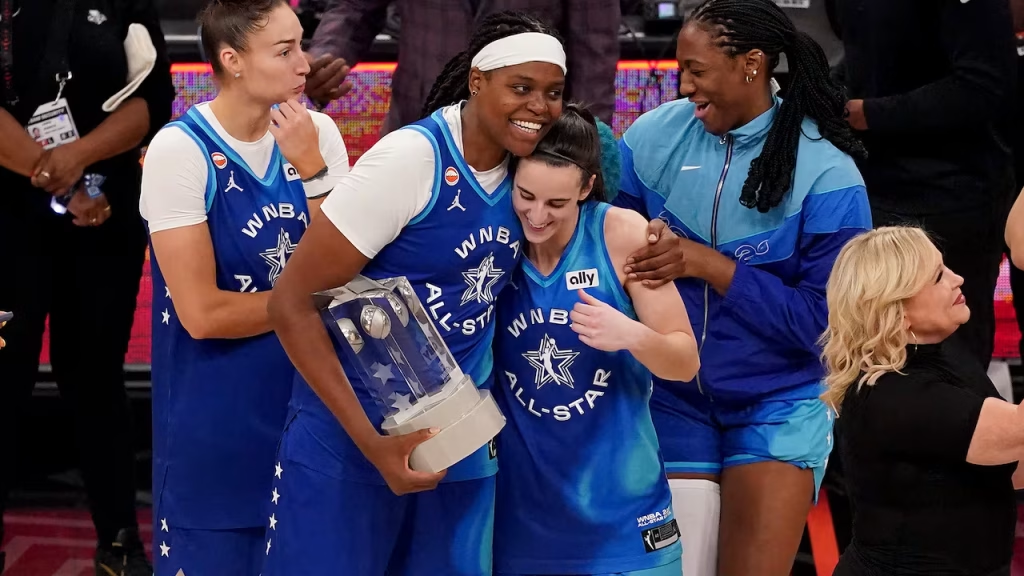
The 2026 WNBA All-Star Game delivered on every front Saturday night at the United Center, as a record crowd watched Caitlin Clark’s Team Spoon outlast Marina Mabrey and Team Coop, 129-122, in a night that mixed history-making performances with a growing storyline around Commissioner Cathy Engelbert’s leadership.

Record Crowd, Record Season

A total of 19,783 fans packed the United Center, setting a new all-time attendance record for a WNBA All-Star Game — topping the previous mark of 19,487, which had stood since 2007. It was a sharp jump from last year’s 16,988 in Indianapolis, and a clear sign of how far the league has come since it last brought the All-Star Game to Chicago in 2022, when the event was held at the smaller Wintrust Arena.

Engelbert used her pregame news conference to frame the weekend as part of a broader breakout season. She noted the league has already surpassed 73 million unique viewers through 117 broadcasts this season — more than the entirety of last season’s record 63 million — and that 29 games have averaged over a million viewers so far, compared to just 11 for all of last season. Attendance leaguewide is up 16% year over year, with more than 2.2 million fans through games at the season’s halfway point. Calling it the league’s “largest, most immersive, and most accessible” All-Star Weekend yet, Engelbert said the growth reflects investments in both player and fan experience.

The Game: Team Spoon Wins a Shootout

Named for Liberty general manager Teresa Weatherspoon, Team Spoon jumped out to an early lead behind long-range shooting from Clark and never fully let go of it, despite a late push from Team Coop (named for Cynthia Cooper-Dyke) that cut the deficit to single digits. The final score, 129-122, capped a game with 127 combined three-point attempts and very little defense — exactly the kind of showcase All-Star weekend is built for.

Eight Team Spoon players scored in double figures. Clark finished with 17 points, four rebounds and five assists, while Allisha Gray added 19 points off the bench. Rookie Olivia Miles nearly posted a triple-double, finishing with 11 points, 12 rebounds and two assists shy of the mark — making her just the third rookie in All-Star Game history to record a double-double.

For Team Coop, Kelsey Mitchell led all scorers with 28 points, with Marina Mabrey adding 23 off the bench, Paige Bueckers contributing 12 points and seven assists, and Dominique Malonga posting a 12-point, 13-rebound double-double. At 20 years old, Malonga became the youngest player in WNBA history to record an All-Star Game double-double.

The Headline: Jonquel Jones Makes History

The biggest individual story of the night belonged to Liberty center Jonquel Jones, who came off the bench to post 22 points, 13 rebounds and eight assists — two assists shy of a triple-double — en route to All-Star Game MVP honors.

The performance made Jones the first player in WNBA history to win all four of the league’s marquee MVP awards: regular-season MVP (2021, with the Connecticut Sun), Commissioner’s Cup MVP (2023), WNBA Finals MVP (2024), and now All-Star Game MVP (2026). She’s also the first player to record double-doubles in four separate All-Star Games.

Jones dedicated the win to her aunt, Marilyn Anita Knowles, who died recently; the game fell on the day of her memorial. “My aunt passed away not too long ago, and today is actually her memorial. I got permission from my family to be here and to celebrate this moment,” Jones said afterward. “This one is for my auntie.”

Jones wasn’t the only player to make history Saturday. Seattle’s Nneka Ogwumike, entering the night second on the All-Star Game’s all-time scoring list behind Maya Moore, scored 11 points to move into first place with 127 career All-Star points.
The Other Story Line: Engelbert’s Leadership Under the Microscope

Even amid the celebration, the weekend doubled as a referendum on Engelbert’s leadership, a topic that has followed her for weeks. Asked to describe her relationship with the commissioner, four-time MVP A’ja Wilson gave a pointed but lighthearted answer, saying her main interaction with Engelbert comes when accepting trophies from her.

Engelbert acknowledged the criticism directly, telling reporters she plans to “institute more frequent communication” with players going forward — including texting them more regularly. It was a notable admission from a commissioner who is currently facing questions about whether her contract, which expires at the end of this year, will be renewed. WNBA players’ union president Nneka Ogwumike declined to say directly whether she believes Engelbert should stay on, saying only that the union will “rock with” whoever is in the role.

Engelbert also addressed player safety and online harassment during her availability, an issue that has intensified this season following high-profile incidents involving Caitlin Clark.

Takeaway

The 2026 All-Star Game captured a league in the middle of two stories happening at once: a business and viewership boom that’s setting records on almost every front, and a leadership credibility question that isn’t going away just because the arena was full. Jonquel Jones’ historic MVP performance and the record crowd will be the headline; whether Engelbert’s promised “more frequent communication” changes the tenor of that second story is one of the bigger threads to watch as the second half of the season begins.

Caitlin Clark Gives Fans an Inside Look at Her Debut Nike Signature Shoe, the Caitlin 1

By LiveWire Sports Media

After more than a year of anticipation, Caitlin Clark has finally pulled back the curtain on her first signature sneaker. The Indiana Fever superstar spent the past week dropping a string of cryptic hints on Instagram before delivering a full, image-packed reveal of the Nike Caitlin 1 — and the rollout has been every bit as carefully choreographed as the player herself.

The Tease Heard Around the Sneaker World

Clark kicked things off by quietly changing her Instagram handle from @caitlinclark22 to @caitlin1 and swapping her profile photo for an extreme close-up of a textured blue material. Sneaker outlets immediately went into overdrive trying to decode the imagery, and it didn’t take long for a second clue to surface: while walking into Gainbridge Fieldhouse before a game against the Toronto Tempo, Clark was spotted wearing two custom friendship bracelets. One read “CAITLIN1.” The other read “10-01-26.”

The friendship-bracelet Easter egg was a nod to Taylor Swift, an artist Clark has been open about being a big fan of, and it gave fans exactly what they were looking for: a release date. October 1, 2026 is now circled on basketball and sneaker calendars alike as the day the Nike Caitlin 1 officially hits shelves.

The Full Reveal: A “Very Normal” Photo Dump

Days after the teasers began, Clark posted what she jokingly captioned a “very, very, very, very normal photo dump” on Instagram. The carousel opened with unrelated lifestyle shots — a basketball covered in blue paint, a Formula 1 outing, some snacks — before shifting into the real headline: multiple images of the Caitlin 1 itself, including one of Clark wearing the shoe and another showing rapper Travis Scott trying on a blacked-out colorway.

The silhouette is a low-top design that nods to the Kobe 5 and Kobe 6 models Clark has frequently worn on court as player-exclusive colorways throughout her career. The debut colorway, dubbed “Racer Blue,” leans heavily into that shade, broken up by a metallic chrome Swoosh on the lateral side, a tan Swoosh on the medial side, and a small gum-rubber detail on the heel of the outsole. Additional colorways have already surfaced in the background of Clark’s reveal photos, including a black-and-chrome pair worn by Travis Scott and what appears to be a green, Grinch-inspired version spotted near a holiday-themed insole graphic.

In Clark’s Own Words

Clark has been candid about how personal this project is to her. “Having my own shoe has been a dream for as long as I can remember, and seeing it come to life is pretty incredible,” she said in a statement accompanying the reveal. “I wanted it to reflect how I play — fast, confident, and ready to let it fly. Nike and I really crushed it. It was a true partnership. They listened to every detail, and the innovation is designed for my game. Seeing the finished product for the first time will forever be a core memory.”

That sense of personal involvement traces back to August 2025, when Nike first named Clark a signature athlete and unveiled her logo — two interlocking C’s with a smaller, hidden C tucked inside. Clark said at the time the logo represented her “magnetic bond with the basketball community” and her “relentless drive, passion, and growth from within.” That logo collection launched in apparel form in October 2025, setting the stage for the shoe to follow nearly a year later.

Release Details

The Nike Caitlin 1 “Racer Blue” is set to release October 1, 2026 through Nike.com and select Nike Basketball retailers. Pricing is set at $140 for adult unisex sizing, $115 for grade-school sizing, and $105 for preschool sizing. The release caps off an eight-year, $28 million sponsorship deal between Clark and Nike that began in April 2024, and it arrives as Clark continues to be one of the most influential commercial forces in the history of women’s sports.

For a player whose impact on the WNBA’s television deals, attendance figures, and merchandise sales has been compared to Michael Jordan’s and Tiger Woods’, the Caitlin 1 represents more than a shoe release — it’s the next step in turning Clark into a permanent fixture of basketball sneaker culture, the way her on-court Kobe player-exclusives already have.

WNBA CBA Breakdown: New Details on Housing, Salaries, and How the 20% Revenue Share Actually Works

The WNBA’s new Collective Bargaining Agreement (CBA) continues to reveal itself as one of the most transformative deals in modern sports. This is not just due to record-breaking salaries. It is also because of how the league is restructuring its entire economic system.

With new reporting from Annie Costabile and additional confirmed financial details, we get a clearer picture. We understand how players will be paid. We also learn how benefits will evolve and how the league’s new 20% revenue-sharing model will function over time.

💰 The Foundation: A Massive Financial Reset

At the center of the agreement is a dramatic increase in compensation:

  • Salary cap jumping from $1.5 million to $7 million in 2026 ()
  • Average salaries projected around $600,000 ()
  • Minimum salaries rising above $300,000 ()
  • Supermax contracts reaching $1.4 million ()

But the most important number isn’t just the salary cap — it’s the ~20% revenue share for players.


📊 How the 20% Revenue Share Actually Works

The headline figure — players receiving about 20% of league revenue — is often misunderstood.

According to multiple reports, this is:

  • An average across the entire CBA, not a fixed yearly percentage ()
  • Likely based on gross or near-gross revenue, a major win for players ()

🔍 Year-by-Year Reality (Projected Structure)

While exact yearly splits haven’t been publicly finalized, league sources and negotiation trends indicate a phased model:

Early Years (2026–2027)

  • Salary cap begins at $7M
  • Revenue still scaling with new media deals
    👉 Players likely receive below 20% effective share
  • Middle Years (2028–2030)
    Media rights and sponsorship growth accelerate
    Salary cap rises significantly
    👉 Revenue share approaches 20% range

    Late Years (2031+)
    Salary cap projected to exceed $10M
    League revenue significantly higher
    👉 Players may receive 20% or more in some seasons

    👉 Bottom line:
    The 20% is not static — it grows with the league and balances out across the life of the deal.

🏠 Housing: A Key Compromise

One of the most important updates from Annie Costabile’s reporting involves housing:

  • All players receive team-provided housing for the first three years
  • Starting in 2029, only players earning $500,000 or less qualify

👉 This creates a tiered system:

  • Lower-paid players keep benefits
  • Higher-paid stars transition to self-managed housing

This reflects a shift toward a more traditional pro sports model.


📊 Tiered Salary System Introduced

The new CBA also introduces a structured pay scale:

  • Rookie minimum: $270,000
  • 1–3 years: ~$277K+
  • 4–6 years: ~$285K+
  • 7–9 years: ~$290K+
  • 10+ years: ~$300K+

👉 This system:

  • Rewards experience
  • Raises the financial floor
  • Creates long-term earning growth

🔒 Core Rule Change Shifts Player Power

Another major structural change:

Beginning in 2027:

  • Only players with 6 or fewer years of service can be “cored”

👉 Impact:

  • Veteran players gain more free agency freedom
  • Teams lose some long-term control
  • More player movement becomes likely

🌍 The Bigger Economic Shift

This CBA signals a fundamental change in how the WNBA operates:

💰 Players Are Now Tied to League Growth

For the first time, compensation is directly linked to:

  • Revenue increases
  • Media deals
  • League expansion

📈 The League Is Betting on Itself

These financial commitments only work if:

  • Viewership continues rising
  • Sponsorship revenue grows
  • Star power continues driving attention

🚀 The Overseas Model May Fade

With salaries reaching:

  • $300K minimum
  • $600K average
  • $1M+ top deals

Players may no longer need to rely on overseas leagues.

💥 Final Take

The WNBA’s new CBA is more than a pay raise — it’s a complete economic redesign.

From a phased 20% revenue-sharing model to housing changes, tiered salaries, and increased player freedom, the league is shifting from a survival model to a growth-driven business.

And while the 20% figure headlines the deal, the real story is how that percentage evolves over time — growing alongside a league that is betting big on its future.

WNBA CBA Just Got Bigger: New Details Reveal $10M Salary Cap Future and Massive League Shift

Screenshot

The WNBA’s new Collective Bargaining Agreement (CBA) is already being called transformational — but the latest details suggest it may be even bigger than initially reported.

According to new reporting from ESPN’s Alexa Philippou, the league’s financial future is set to expand dramatically, with long-term projections pushing the salary cap into unprecedented territory.

A $10 Million Future Is Coming

While early reports confirmed a $7 million salary cap starting in 2026, new details reveal that the cap is expected to exceed $10 million by the end of the agreement. ()

This signals not just growth — but sustained investment in the league over time. The new deal is expected to run for multiple years, giving teams and players long-term financial stability and planning power.

Massive Salary Growth Across the Board

The financial jump isn’t limited to team spending.

Under the new agreement:

  • Supermax salaries start at $1.4 million
  • Average salaries project around $600,000
  • Minimum salaries rise above $300,000

These numbers represent a dramatic leap from 2025, when:

  • The average salary hovered near $120,000
  • The minimum salary was just over $66,000 ()

This is one of the largest pay increases ever seen in professional sports within a single agreement cycle.

Revenue Sharing Finally Moves Forward

Another key breakthrough is revenue sharing, with players expected to receive nearly 20% of league revenue across the deal.

This has been one of the most contested issues in negotiations — and its inclusion marks a shift toward a more modern sports business model, where players directly benefit from league growth.

More Than Just Money: Structural Changes

Beyond salaries, the new CBA is expected to:

  • Improve player benefits
  • Expand professional standards
  • Solidify travel accommodations like charter flights
  • Create a more stable league structure moving forward ()

These upgrades bring the WNBA closer to the operational standards seen in major men’s leagues.

What This Means for the League

This agreement reflects a league that is no longer operating on potential — it’s operating on momentum.

The WNBA has seen explosive growth in:

  • Viewership
  • Media coverage
  • Star power

And now, the financial model is beginning to catch up.

The Bigger Picture

The most important takeaway isn’t just the $7 million starting cap — it’s the trajectory.

With projections exceeding $10 million, the WNBA is signaling long-term belief in its product, its players, and its future.

For players, this means:

  • Less reliance on overseas leagues
  • More financial security
  • Greater leverage in contract negotiations

For fans, it means a stronger, more competitive league.

Final Take

The WNBA isn’t just evolving — it’s accelerating.

And with these latest details, one thing is clear:

This CBA isn’t just a step forward… it’s a complete reset of what women’s professional basketball can be.

Marina Mabrey Breaks Silence on Shoving Caitlin Clark — But Is Anyone Buying It?

Today, a headline caught my attention while scrolling Reddit — an article about Connecticut Sun guard Marina Mabrey finally speaking on that shove of Caitlin Clark.

If you’ve been following the WNBA this season, you know exactly the moment I’m talking about. It happened June 17 during the Fever–Sun game. In the third quarter, Fever rookie star Caitlin Clark was poked in the eye by Sun guard Jacy Sheldon while Sheldon was playing defense. That led to a brief scuffle between Clark and Sheldon — and then, seemingly out of nowhere, Mabrey came in and shoved Clark to the ground.

It instantly became one of the most talked-about moments of the 2025 WNBA season, sparking weeks of debate about how Clark is treated by other players in the league. Many fans argued that Mabrey should have been ejected along with others involved, like Jacy Sheldon and Tina Charles.

At the time, Mabrey didn’t say much — other than an infamous Instagram Live moment where she joked about the incident. But now, nearly two months later, she’s speaking publicly in an August 10 interview with Mark Medina.

Mabrey’s Side of the Story

In the interview, Mabrey claimed that she thought shove was upgraded to a flagrant foul because of how fans reacted.

“They gave me a tech for it initially. I don’t care. Honestly, I really don’t. Obviously, I’m not trying to hurt anyone. I’m not trying to go after certain players for certain [stuff].”

She also insisted that she and Caitlin Clark were “cool,” recalling past matchups where Clark had thrown her into the benches during the playoffs without any lingering hard feelings. Mabrey said she “probably overreacted a little bit” but was protecting her teammates.

The History Between Mabrey and Clark

For many fans, Mabrey’s explanation rings hollow because this isn’t the first time she’s mocked or taken shots at Clark. Last season, after DiJonai Carrington poked Clark in the eye during the playoffs, Mabrey was caught on camera making fun of it from the sideline.

Since joining Connecticut, Mabrey’s confrontations with Clark have seemed to escalate — from verbal jabs to physical plays. The June 17 shove wasn’t an isolated moment; it felt like the culmination of ongoing tension.

A Pattern of Targeting?

Whether or not Mabrey wants to admit it, Caitlin Clark has faced targeted physicality from multiple players since entering the league. From Chennedy Carter’s hard foul to Brittney Griner’s near clothesline, Clark has been on the receiving end of some rough treatment — and Sophie Cunningham even admitted teams had game-planned for how to “welcome” Clark to the WNBA.

In the Connecticut matchup after the shove, Jacy Sheldon reportedly used similar tactics again, even attempting a groin shot. That was also the game Clark suffered an injury that has kept her sidelined since.

Why Speak Now?

Two months later, Mabrey’s comments feel less like genuine reflection and more like image control. If she truly felt misunderstood, why not address it in the postgame presser back in June? Why wait until August — and only after the public outrage had cooled — to share her version?

For many fans, this belated explanation isn’t enough to erase the perception of Mabrey as one of the league’s dirtier players. Actions speak louder than interviews, and we’ll see just how “cool” things really are when the Fever face the Sun again — possibly with Clark back in the lineup.

Because if Jacy Sheldon isn’t there to guard her this time, will Mabrey step up for that assignment? And if so, will it be clean competition… or more of the same?

Caitlin Clark, Civil Rights & the WNBA: The Story That Could Rock Women’s Sports to Its Core

There are moments in sports that become more than just games — they become cultural touchstones, legal powder kegs, and political flashpoints. One of those moments may be happening right now, and at the center of it all is a 23-year-old phenom: Caitlin Clark.

A recent Wall Street Journal article by Sean McLean has ignited what could become the most significant legal and political story in the history of women’s sports. Stephen A. Smith, one of the most powerful voices in sports media, covered it in depth — and now it’s time to break down exactly why this matters.

Because this isn’t just about basketball anymore.

Caitlin Clark’s Seismic Impact on the WNBA

The numbers don’t lie — Caitlin Clark is the WNBA’s biggest star and economic engine:

  • Merchandise sales skyrocketed 601% since she joined.
  • Indiana Fever viewership jumped 170%.
  • League Pass subscriptions surged 366%.
  • App engagement soared 613%.
  • Her endorsements have topped $11 million.
  • The Indiana Fever’s value has tripled.

She is, by all measurable metrics, the face of the league. And yet, rather than being protected and embraced, she’s been targeted — both physically on the court and, as many are now alleging, institutionally.

From Target to Legal Flashpoint

The Wall Street Journal article lays out what may be the beginnings of a legal case — even hinting at civil rights violations. This isn’t just speculation. The idea is that Clark may be facing disparate treatment based on her race, fame, or influence — and the league’s leadership could be liable for not intervening.

Some key claims:

  • Caitlin Clark is being relentlessly targeted on the court with excessive physicality.
  • The WNBA has failed to protect her, despite her value to the league.
  • That failure could represent a hostile work environment.
  • There is precedent: The EEOC already launched an investigation into the WNBA for allegedly retaliating against Dearica Hamby for being pregnant.

Mlan’s article essentially calls this a pattern — a culture of disregard for the rights of women athletes, even stars like Clark.

Political Dominoes Are Already Falling

If this sounds extreme, consider this:

  • Senator Jim Banks already sent a letter to the league demanding answers over Clark’s treatment — over a year ago.
  • There’s rising pressure from Congress, civil rights groups, and watchdog organizations.
  • With Donald Trump on the campaign trail, political operatives may see Clark as a symbol of unfair treatment, galvanizing conservative voters.

As Stephen A. Smith said, this situation has all the ingredients to explode politically.

Mainstream Media Can’t Ignore It Anymore

From ESPN to independent creators, this topic is reaching critical mass. What started as whispers on YouTube, Twitter, and Reddit now has the attention of First Take. It won’t be long before other platforms — Netflix, 30 for 30, documentaries — start taking notice.

There are receipts, video evidence, and fan outrage.

Players like Sophie Cunningham, Candace Parker, and Rebecca Lobo have already weighed in, stating plainly: Caitlin Clark is being targeted.

Will Corporate Sponsors Stay Silent?

Let’s not forget the business side. Brands like Nike, Gatorade, and State Farm have invested millions in Caitlin Clark. If the WNBA continues to allow a climate that endangers her safety and image, these brands may demand accountability.

Future endorsement deals may even include clauses ensuring a player’s protection and image aren’t damaged by league mismanagement.

Inside the WNBA: Cracks Are Beginning to Show

There’s division brewing:

  • Some veterans allegedly see Clark as being propped up unfairly.
  • Others recognize she’s being targeted, physically and politically.
  • The Players Association (WNBPA) may face internal strife — torn between protecting a rising star and preserving unity.

And then there’s the Indiana Fever — her employer. If Clark’s injuries continue and no protection is put in place, they too could face scrutiny and legal pressure.

Fan Backlash & the Cultural Divide

Clark’s fanbase is massive, loyal, and vocal. They are not going to sit by quietly.

Social media campaigns are already underway. YouTube creators are documenting every foul, every moment of mistreatment. Conservative media has started framing the WNBA as hostile to Clark and “mainstream America.”

This could grow into a cultural war — old guard vs. new fans, progressivism vs. populism, equity vs. favoritism.

The Bottom Line: A Bombshell Was Dropped

Sean McLean didn’t just write an article. He lit a fuse.

The WNBA is now in the public spotlight, not just for its basketball but for its handling of civil rights, workplace protections, and league governance.

If the league fails to act, Congress might. If the Commissioner doesn’t send a clear message, sponsors might. If this escalates further, legal action may become inevitable.

This isn’t about fouls anymore — it’s about how a league protects (or fails to protect) its most valuable asset.

Final Thought

The WNBA has been fairly warned. Caitlin Clark’s impact has forever changed the league — for better or worse, that now depends on what happens next.

If this season continues with unchecked aggression, inconsistent officiating, and silence from leadership, don’t be surprised when lawyers, lawmakers, and legacy media come knocking.

Because this is a story that matters — and it’s only just beginning.

Aari McDonald’s 27-Point Masterclass Powers Indiana Fever Past Phoenix Mercury

The Indiana Fever just sent a message to the WNBA—and they did it with authority.

In what may be their most defining win of the season, the Fever dismantled the Phoenix Mercury 107-101 in a game that felt deeply personal. This wasn’t just about climbing up the standings. It was about proving a point.

And leading the charge? Aari McDonald, who turned in a career-best performance with 27 points, showing grit, poise, and playmaking brilliance. This game may just be her WNBA coming-out party.

The Unsung Hero Becomes the Star

McDonald, who arrived on a hardship contract earlier this season, wasn’t expected to be the centerpiece of the Fever’s offensive engine. But with Caitlin Clark out and star players like Kelsey Mitchell, Aaliyah Boston, and Natasha Howard struggling in the first half, she stepped up in a massive way.

Her second-quarter explosion helped the Fever outscore the Mercury 35–20, including a 10-0 run that completely flipped the game.

McDonald finished 7-of-11 from the field, 3-of-4 from beyond the arc, and was relentless attacking the rim. She wasn’t just scoring—she was orchestrating.

Bench Mob Brings the Energy

The Fever’s bench played arguably their most complete game of the season. Chloe Bibby delivered another strong performance with 10 points, proving she belongs in this rotation. Sydney Colson knocked down timely threes and brought energy. Lexie Hull locked in on defense, and DeWanna Dantas contributed valuable minutes down the stretch.

In total, the Fever’s bench poured in 32 points, matching Phoenix’s second unit and showing that depth might finally be a strength in Indiana.

Personal History with DeWanna Bonner Fuels Fire

This game was about more than just standings. It was about pride. Former Fever player DeWanna Bonner—who left the team on rocky terms after a rocky offseason—returned to Indiana with something to prove. But instead of redemption, she was met with boos, frustration, and a stifling defensive effort.

Bonner finished with just 4 points on 1-for-4 shooting and looked visibly flustered by the crowd and her former teammates. If revenge was the motive, it backfired badly.

Final Stats & Game Breakdown

  • Indiana Fever: 51% FG, 45% from three, 32/38 FT (84%)
  • Phoenix Mercury: Outrebounded 33–31
  • Bench Points: 32 apiece
  • Largest Lead: 12 for both teams
  • Fever Comeback: Down by 12 in Q1 → led by halftime

In the fourth quarter, Aaliyah Boston took over with 14 points, finally breaking free after a quiet start. Despite foul trouble, Kelsey Mitchell and Natasha Howard’s leadership kept the team composed.

What’s Next for Indiana?

With three straight wins, the Fever are heating up at just the right time. If they can pull off a victory in Dallas and then take care of business against the Seattle Storm, they’ll be riding a five-game win streak—even without Caitlin Clark on the floor.

This game wasn’t just a win. It was a statement.

Indiana Fever Signed Brianna Turner Despite the Controversy

The Indiana Fever’s signing of veteran All-Defensive Team forward Brianna Turner is a huge addition of defense and needed veteran experience into a rebuilding roster. The signing on February 17, 2025, is the newest signee to the Fever’s active rebuilding initiative. The team has been busy filling up the seemingly holes in the team in order to be title contenders. 

Turner, a product of Chicago Sky for this past season, has a good defensive resume highlighted by two All-Defensive Team selections (2020, 2021) and the record-breaking 2020 game in which she became the first WNBA player to ever accumulate at least 10 points, 20 rebounds, five assists, and four blocks in one game. During her six years in the league, Turner’s averages have consistently been 4.6 points, 6.3 rebounds, and 1.2 blocks per contest.

Fever COO and General Manager Amber Cox emphasized Turner’s defensive impact: “Throughout her career, Brianna has established herself as an elite defender in the WNBA. She adds depth to our post rotation, bringing exceptional shot blocking and rebounding abilities to our team. Brianna’s basketball IQ is off the charts, she plays with great pace and is another fantastic veteran presence for us, both on and off the court.”

Turner’s arrival in Indianapolis comes with both excitement and of course anticipation. “I am ecstatic to join the Fever organization and compete for a championship,” Turner stated in the team’s press release. “I was drawn to the team’s commitment to investing in women and providing the best professional atmosphere for success. The front office and coaching staff have assembled a dynamic roster that I’m looking forward to learning from and growing with throughout the season.”

The Notre Dame alumna, who helped drive the Fighting Irish to their second national championship in 2018, brings title lineage to a Fever franchise on the lookout for returning to the playoffs. From being the No. 11 overall draft choice in 2019 (Atlanta drafted and quickly traded to Phoenix), her road to being amongst the best defensemen in the league indicates strength and resilience.

Turner’s signing, a reported one-year, $85,000 contract, comes at a crucial juncture for the Fever. Her defensive ability will be valuable in stabilizing Indiana’s interior defense, and her remarkable presence will be significant in providing guidance to the team’s younger player.

Turner’s signing also addresses some of the needs in the Fever’s roster makeup. Her shot-blocking ability and rebounding presence cover large gaps in the team’s defense, while her high-level basketball smarts and veteran poise are compatible with the desire of the company to establish a functioning winning culture.

As the WNBA expands with increasingly talented and competitive players, Turner’s signing is not just the addition of another player to the roster – it is a statement of intent from the Fever franchise about building an even-keeled, championship-caliber roster. With the 2025 season approaching, Turner’s integration into the squad will be key to the Fever’s aspirations for returning to the playoffs and, potentially, to being a true championship contender.  

Indiana Fever Hire Ex- Sun Coach Stephanie White

The Indiana Fever have made a shocking announcement; they are bringing back Stephanie White as head coach. This is rather an exciting return to Indianapolis for White, previously coaching the Fever from 2015 to 2016. Her hiring comes after the recent departure of Christie Sides, who led the Fever to a 20-20 record last season and guided the team into their first playoff appearance since 2016. The reappointment of White has come at such a time when the Fever would want to capitalize on a young core and work themselves into a new era of success.

White’s ties with the Fever and Indiana go way back. As a former player with the franchise, White helped it grow into its eventual championship run. She was part of the staff that saw them win the 2012 WNBA title under head coach Lin Dunn. White finally took over the reins in 2015, guiding the team to the WNBA Finals in her first head coaching season. After two seasons with the Fever, she left to coach Vanderbilt University’s women’s basketball team. Since then, though, she has taken quite the interesting road-most recently with the Connecticut Sun. She comes off an award-winning season this year, acquiring WNBA Coach of the Year in 2023 for her efforts. White’s success with the Sun led them to two playoff semifinal appearances and also made her a hot commodity on the coaching market after she parted ways with them this offseason. This might be the main reason for her reappointment.

Kelly Krauskopf, the Fever’s president of basketball operations, said in a news release that White has an excellent understanding with the franchise and has been in and around the Fever culture. 

“Stephanie is a part of the fabric of this franchise, both as a former player and as a member of our championship coaching staff, so I’m quite familiar with her elite basketball IQ and leadership style. I am confident there is no one who better understands our culture or is more equipped to lead our group of players to the next level.” Krauskopf said, praising White for her high basketball IQ and leadership qualities.

Livewire Sports Media breaks down Stephanie White Hire

The return of White holds even more meaning given the promising talent within the Fever roster. The team is likely to bring back a young and bright performance this season especially by the recent WNBA Rookie of the Year winners in Aliyah Boston and Caitlin Clark. The ability of these players, complemented by the experience and strategic acumen of White, puts the Fever in a favorable light for playoff success over the coming seasons.

For White, the return to Indiana is also a return to home. Born and raised in West Lebanon, Indiana, White went to Purdue University, where she led the Boilermakers to the NCAA women’s basketball championship in 1999. Her roots in Indiana and her love for the state’s basketball culture make this opportunity particularly meaningful.

“I am incredibly proud and honored to return home to Indiana and lead the Fever during such a pivotal moment in this franchise’s history, as well as during such an important time throughout women’s athletics,” White said in a team statement. “This franchise has and always will be committed to winning and I look forward to working every day to help deliver another WNBA title to the greatest basketball fans in the world.”

Unrivaled making a push to recruit Caitlin Clark

Get ready for a new team that’s on a journey of taking over the Women National Basketball Association; the Unrivaled Basketball Team.

 The new WNBA team plans to start off its inaugural season this coming January with a bold vision, top-shelf media deals, and an impressive roster of talent which they hope will earn them a legitimate place within the league. Among many of their visionary moves of taking over is their aspiration of recruiting Caitlin Clark, The star from the Indiana Fever. We all know Caitlin is a bag of talent and rose to limelight with sterling plays and impressive records that won her fans’ hearts all over the world.

Caitlin Clark recently completed her rookie year in the WNBA with a bang; she won the Rookie of The Year Award with an almost unanimous voting. Her selection into the All-WNBA First Team, along with her contribution to Indiana Fever’s strong performances this past season has put her in the spotlight. But after a very exhausting season, Clark announced she would take a break from basketball until April 2025 to rest and recover.

For the new team Unrivaled, this might pose as a challenge as much as it might be a chance for them to sign the talented guard ahead of their maiden season. The Unrivaled are keen on signing Clark regardless of her desire to go on break.

The team was co-founded by top sports figures Napheesa Collier and Breanna Stewart, and are committed to providing a new level of exposure for women’s basketball. They’ve already agreed to a multi-year media rights deal with major networks like TNT and truTV, which guarantees their games prime-time coverage and even more access on the Max streamer. A deal that will televise 45 primetime games speaks to their ambition to bring women’s basketball to the highest order of visibility.

Perhaps at the core of this ambitious venture is a hope that Caitlin Clark, one of the most talented players in the WNBA, will be part of the league’s launch. Clark’s rookie season brought her individual accolades and also played an important role in the rise in viewership of the WNBA league as a whole; from packed arenas to record breaking audiences on TV. She’s proven to be a game-changer both on and off the court. That is exactly why Unrivaled wants her talent for their maiden season.

Unrivaled, for its part, is prepared to make its pitch. According to sources around the league, it intends to contact Clark in the coming weeks with an offer that’s hard to refuse. They also are counting on the appeal of playing with other WNBA stars like Angel Reese, Kelsey Plum, Brittney Griner, and Skylar Diggins-Smith, along with the chance to be a part of something new and revolutionary in the women’s professional basketball scene, which can make her reconsider her plans for the off-season. Of course, with 26 of the team’s 30 player spots supposedly taken, there is still hope that Clark will take one of the four remaining spots.

The 2024 WNBA season is closed, and the offseason has started. All eyes are on Clark. Will she let Unrivaled’s offer sway her from that plan, or stick to it?